You don't know what you don't know
You can prompt AI to build things, but you can't tell if what it built is any good — or why it fails.
A 12-week course for founders, PMs, analysts, marketers and consultants — anyone creating with AI without writing the code themselves.
12 weeks live · €100 / month · 15 onsite seats · 30 online seats · No coding experience required
Why this exists
Most professionals using AI tools today fall into the same trap. You can generate code, build automations and ship things faster than ever. But the moment something breaks, or a colleague asks you to explain what you built, or you need to hand it off — you end up backed into a corner.
You don't need to learn to code. But you do need a mental model for what's happening under the hood. That's the gap Basis was built to close.
You can prompt AI to build things, but you can't tell if what it built is any good — or why it fails.
Describing software in plain text is like describing a building by talking about the furniture. Something structural always goes unspecified.
When something breaks, you paste the error back in and hope. There is a better way.
What Basis is
This isn't a coding course. You won't write functions or memorise syntax.
Instead, you'll build the conceptual layer that sits above the code — the understanding that lets you direct AI with precision, read what it produces with confidence, and manage what gets built without needing to build it yourself.
Think of it as the difference between being a passenger and being a navigator. You don't need to drive. But you need to know where you are.
Learn how software is actually organised — not in code, but in concepts. What a server is. What a database does. What an API means. Explained through situations you've already been in.
Learn to describe what you want to build so AI can actually execute it. Visual, structural, unambiguous. This is the skill that separates people who get results from people who get chaos.
Know when to trust AI output and when to question it. How to diagnose a broken thing. How to hand off a project without losing ownership of it.
Is this for you?
You're shipping a product with AI faster than seemed possible. But every time something breaks, you're one bad debug session away from losing the thread entirely.
You own the product but don't write the code. You prototype with AI, talk to engineering, translate between business and technical teams. The middle is where you live — and where most things break.
You use AI to build dashboards, scripts and reports. But when stakeholders ask how it works, or something breaks 30 minutes before the deadline, you end up in no man's land.
You ship landing pages, email flows and growth experiments — all built with AI. Until one of them breaks at the worst possible moment, and you can't say why.
You sell smart and ship fast. AI lets you build prototypes for clients in hours instead of weeks — but you need to know what's actually under the hood before you hand them over.
You're in high school or university and AI is already part of how you'll work. A dedicated starting group meets every Thursday — 120 minutes per session, on site at Robotilnitsa, with their support.
If you've ever thought “I wish I understood what was actually happening here” — Basis is for you.
Basis is not for people who want to learn to code professionally, or for developers looking to improve their engineering skills. If you want to go deep technically, there are better paths. This course is specifically for people who need to manage, direct and communicate — not implement.
12-week curriculum
The course is structured around real problems, not technical categories. Each week we start with a situation you already recognise — and the concepts emerge from solving it, not the other way around.
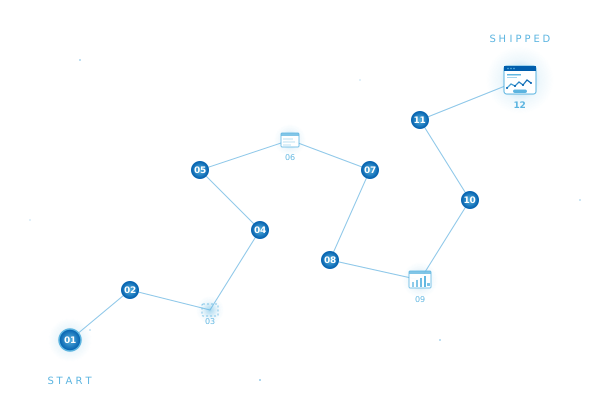
How to describe what you want to build. Introduction to the mental model of software as layers. Your first conversation with AI that actually produces something useful.
How to read code without knowing how to write it. What to look for. How to ask AI to explain its own output. Building your first instinct for quality.
What “environment” means. The difference between local and live. A first step toward real deployment.
What APIs are and how to visualize them. How to direct AI to connect two systems. Reading documentation without panic.
What databases actually are, in plain terms. The difference between types of data storage. Directing AI to set up and query data correctly.
What authentication really involves. Why it's one of the most important things to get right. How to make sure AI builds a safe and reliable user system.
Mental models for debugging. How to read error messages. How to direct AI to find the problem and fix just that — rather than rewrite everything from scratch.
Scripts vs. applications — what's the difference and which do you need. Building your first automation workflow with AI.
What it means to call an AI model from your own software. Building AI features with full understanding of what's happening.
The concept of software architecture. How to communicate the shape of a project to AI — and to humans.
Documentation for non-coders. How to brief a developer. How to stay in control of a project you didn't build yourself.
Consolidation. You present or demo your own project. Shaping and sharing your own framework for tackling any new problem from here on.
Outcomes
A mental model for software you can apply to any project, any tool, any AI.
The ability to describe what you want with enough precision that AI can actually execute it.
Confidence reading AI-generated code — knowing what to look for, what to question, what to trust.
A vocabulary for talking to developers, technical colleagues and AI tools with authority.
A working side project you've built and understand end-to-end.
Access to a community of professionals doing the same work — translating software for the AI era.
Meet Dobrin
Founder of TechVector
I've spent my career at the intersection of software architecture, product and user experience — shaping how complex systems get built, explained and handed between technical and non-technical teams. I founded TechVector — a place from which to help the tech ecosystem grow.
I see a future where writing code will be replaced by capable people creating software. Education has to change to meet that moment. Basis is my vision for how learning evolves in this new reality.
Questions
None whatsoever. Basis is built for people who have never written code and don't intend to. If you already code, you'll still find value in the mental models and communication frameworks — but the course assumes zero prior knowledge.
About 7–8 hours. A live core lesson, a hands-on exercise on your own project, and time in the community. Designed to fit around a full-time job.
Small and live — video sessions, direct access to me, and a private community channel for questions between lessons. Later cohorts may move more asynchronous; the first cohort keeps the highest level of access throughout.
From week one you'll be building something real — a small tool, automation or app relevant to your own work. Every week's lesson applies directly to your project. By week 12 you'll have something working that you actually understand.
Yes. The community is central to Basis, not an afterthought. The goal is to build a group of professionals who speak this language together and stay current as AI tools evolve.
The course costs €100 per month for the 12-week program. Joining the waitlist is free, carries no commitment, and gives you first access when applications open.
Cohort 01
Join the waitlist to be first in line — and get early access to course materials before it begins.
€100 / month 12-week program